All peptides are for research intend use only.
There are compounds that attract scientific attention for a season, and there are compounds that keep earning it decade after decade. GHK-Cu — copper peptide — is firmly in the second category. First isolated in human plasma in the 1970s, it has remained a subject of serious scientific inquiry ever since. Here is what the research currently says, and why it belongs in any well-stocked peptide research programme.
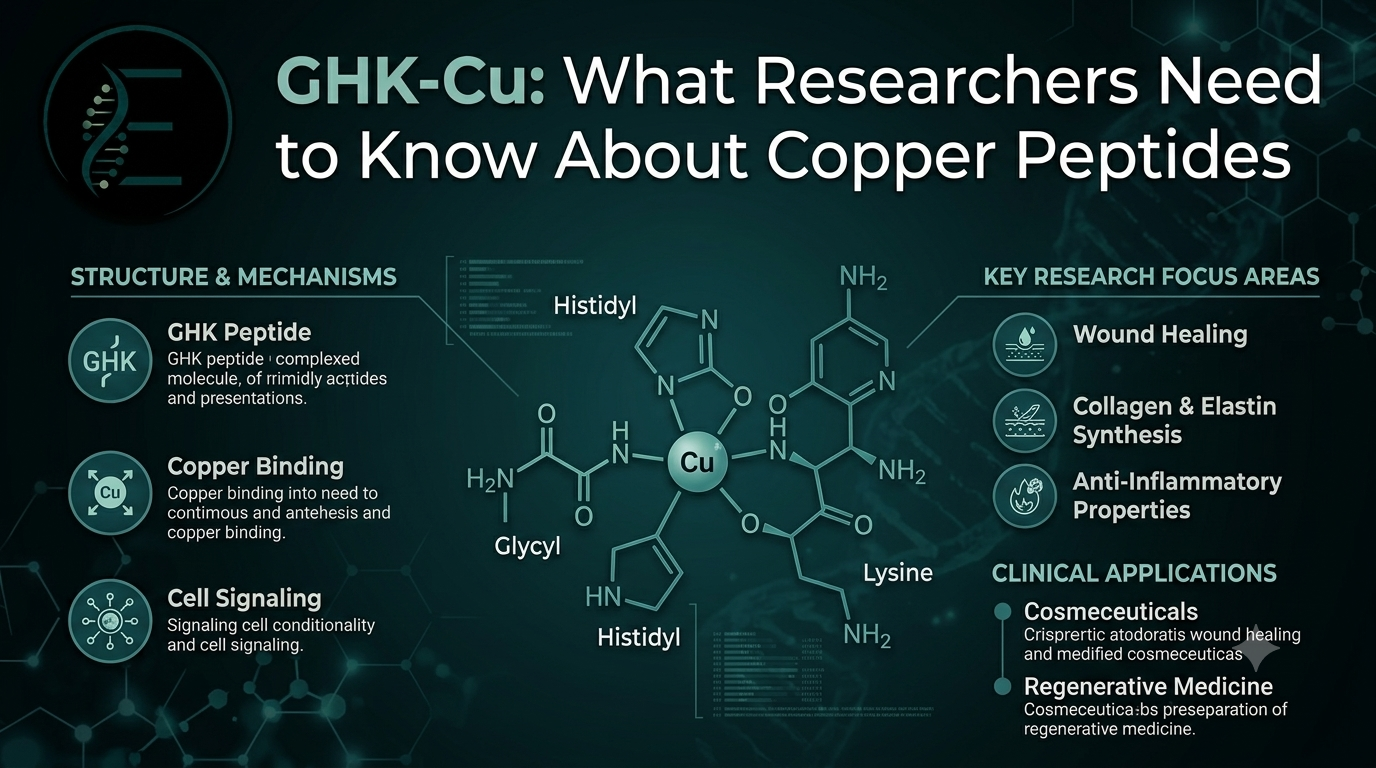
GHK-Cu is a naturally occurring copper complex consisting of the tripeptide glycyl-L-histidyl-L-lysine bound to a copper (II) ion. It is found in human plasma, saliva, and urine, and its concentration in the body measurably declines with age — from approximately 200 ng/ml at age 20 to around 80 ng/ml by age 60. That decline has made it a focal point for researchers studying the molecular mechanisms of ageing and tissue repair.
The scientific literature on GHK-Cu is extensive and spans multiple disciplines. Researchers have investigated its role in a range of biological processes, including:
Wound healing and tissue remodelling — GHK-Cu has been studied for its apparent ability to stimulate collagen and glycosaminoglycan synthesis, both of which are central to tissue repair. Studies have examined its influence on fibroblast activity and skin barrier recovery.
Anti-inflammatory activity — Multiple studies have explored GHK-Cu’s capacity to modulate inflammatory pathways, with particular interest in its effect on the NF-κB signalling cascade.
Gene expression — Perhaps most compellingly, research suggests that GHK-Cu influences the expression of a significant number of human genes. A widely cited analysis identified over 4,000 genes whose activity appeared to be modulated by the compound — a finding that has drawn considerable attention from researchers in the fields of epigenetics and systems biology.
Neurological research — More recent studies have begun examining GHK-Cu in the context of neuroprotection, exploring its potential relevance to oxidative stress in neural tissue.
Copper peptides are particularly sensitive to impurities. Copper itself is a reactive ion, and any contaminant present in a GHK-Cu compound can introduce confounding variables that undermine research integrity. This is not theoretical — it is a documented problem in research settings where substandard compounds are used.
At Epigen, every batch of GHK-CU-COPPER is verified at 99%+ purity by an independent third-party laboratory, with a Certificate of Analysis available for each specific batch number. If you are running research where compound integrity matters — and it always does — that documentation is non-negotiable.
All information in this article is provided for scientific and educational reference. GHK-Cu products supplied by Epigen are intended strictly for research and laboratory use. They are not approved by SAHPRA for human therapeutic use and are not intended for self-administration.